
Beyond the CapEx: What Comes Next for AI
AI infrastructure spending continues to reshape the technology landscape, but investor focus is beginning to shift. As capital deployment reaches unprecedented levels, the key question is no longer how much companies are spending, but how effectively those investments can be monetized.
AI Infrastructure · Equity Research
AI capital expenditure remained one of the dominant themes across the latest technology earnings season.
Executive Summary
Artificial intelligence (AI) capital expenditure remained one of the dominant themes across the latest technology earnings season. Major hyperscalers either reaffirmed or increased infrastructure spending plans, reflecting continued investment in data centers, AI compute and supporting infrastructure despite a mixed macroeconomic backdrop.
The effects of this investment extend well beyond the companies deploying capital. Semiconductor manufacturers, networking providers, server vendors, power infrastructure suppliers and data center operators continue to benefit from elevated AI-related spending. At the same time, the increasing scale of capital deployment has shifted investor attention toward the sustainability of spending, potential monetization pathways and the broader implications for companies across the AI ecosystem.
AI CapEx Snapshot
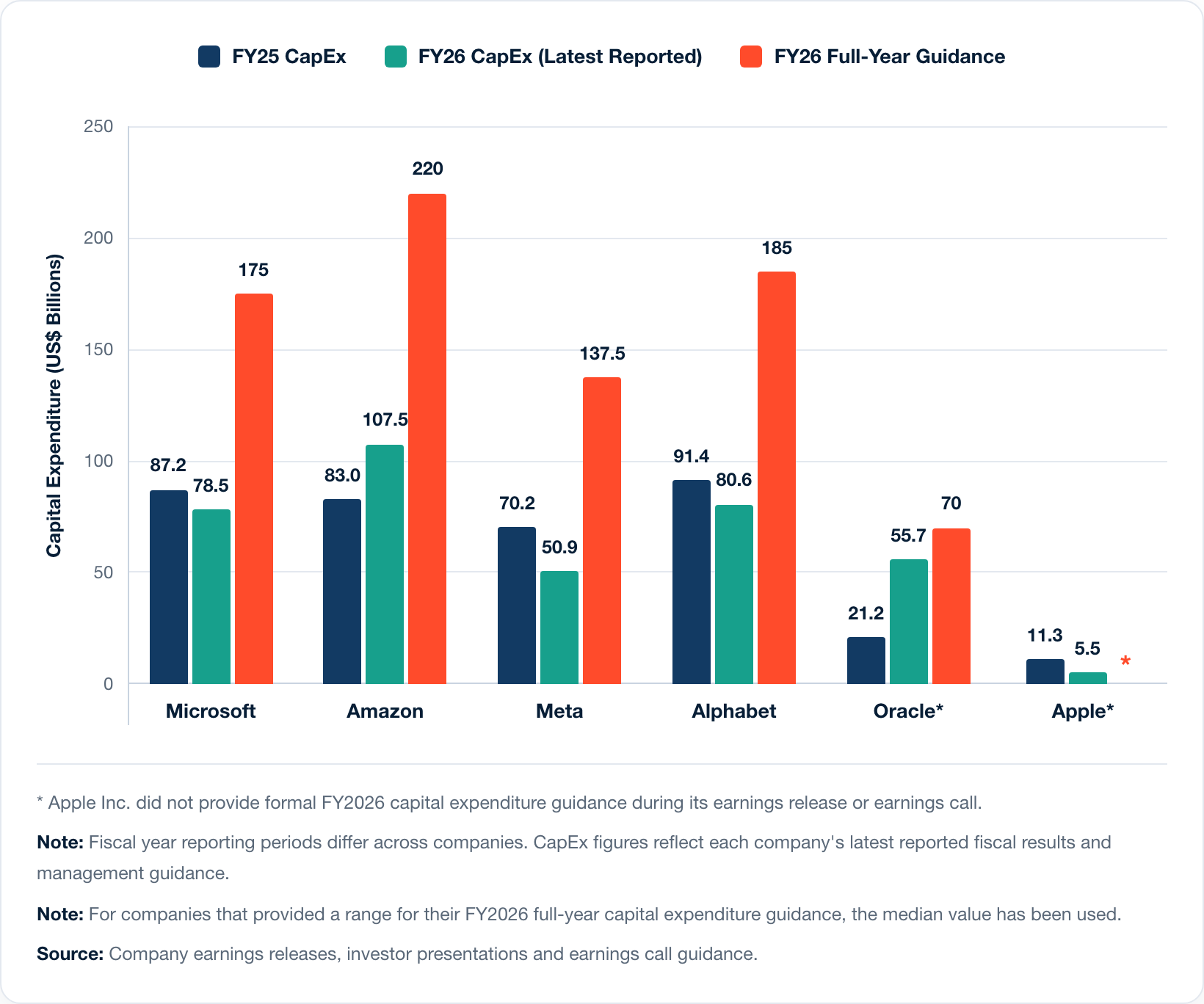
Hyperscaler capital expenditure: FY25, latest reported FY26 and FY26 full-year guidance (US$ billions).
Cross Company Signals
AI Infrastructure Becomes a Strategic Priority
A common theme across earnings calls was the sustained pace of AI infrastructure investment. Companies maintained or increased spending plans on data centers, GPUs, networking and supporting infrastructure, with management teams consistently citing demand that continues to exceed available capacity. More importantly, AI infrastructure is increasingly being treated as a recurring strategic investment rather than a one-time expansion cycle. As AI models become larger and inference workloads continue to grow, hyperscalers continue to view infrastructure spending as a core component of their long-term technology strategy rather than a discretionary capital allocation decision.
Focus is Gradually Expanding Beyond CapEx
Although capital expenditure continues to attract significant investor attention, earnings discussions increasingly included topics such as AI monetization, utilization, revenue contribution and returns on investment. This suggests that market focus is broadening beyond the scale of investment itself toward the economic outcomes those investments may generate.
The AI Infrastructure Value Chain
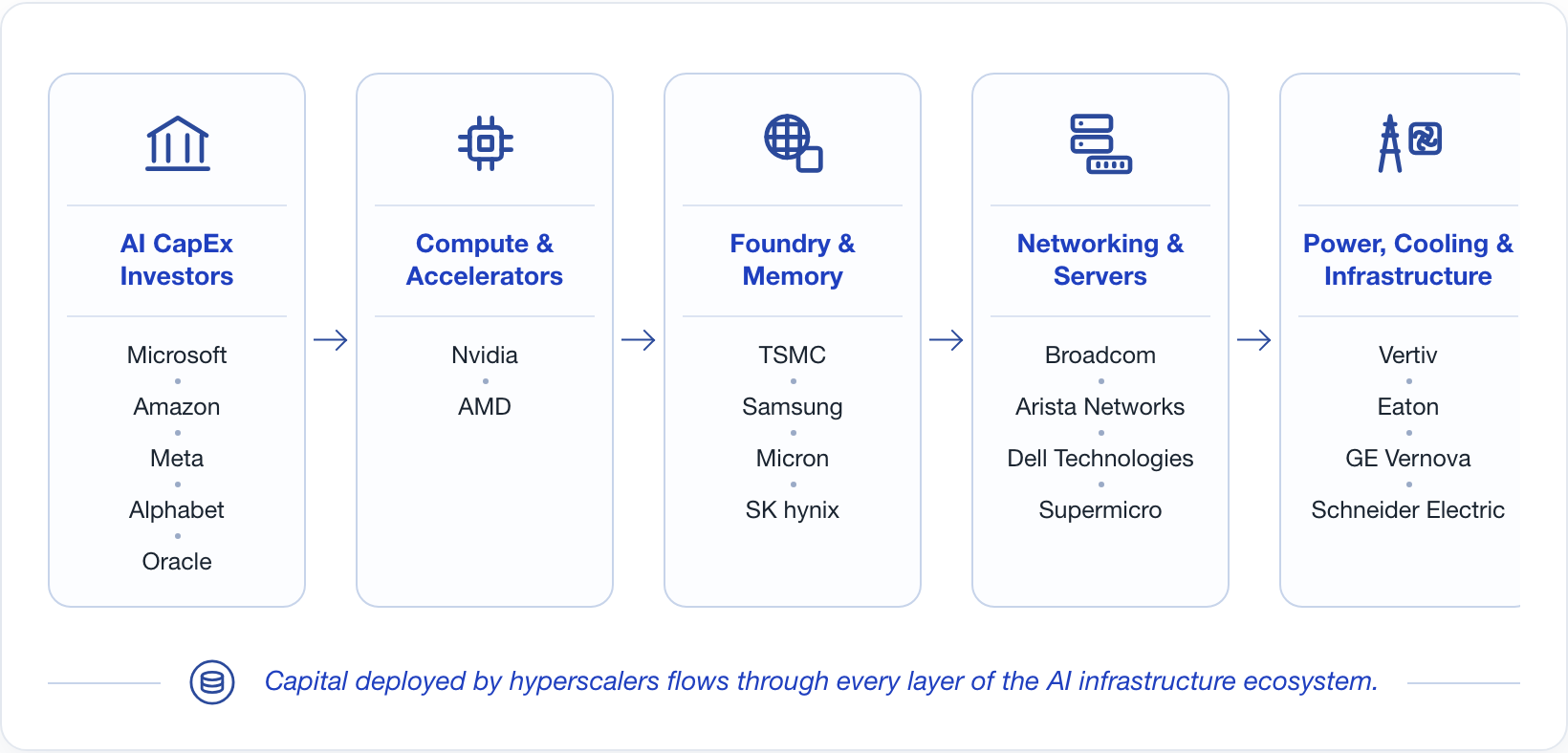
The AI infrastructure value chain, from the hyperscalers deploying capital through to the data center operators.
Who Benefits Most From AI CapEx
The benefits of AI infrastructure spending extend well beyond the hyperscalers deploying capital. Companies supplying GPUs, networking equipment and advanced semiconductors remain among the most direct beneficiaries, supported by continued demand for compute infrastructure. Memory manufacturers, foundries, server vendors, power equipment suppliers, cooling specialists and data center operators also participate across different stages of the infrastructure buildout.
The degree of exposure varies across the ecosystem. Some companies derive a significant proportion of growth from hyperscaler AI investment, while others benefit through broader technology or industrial end markets. As a result, changes in AI infrastructure spending are unlikely to affect all participants equally.
What Happens If AI CapEx Normalizes?
Current investment levels reflect continued expansion of AI infrastructure across the technology sector. If capital expenditure growth were to moderate, the implications would likely differ across the value chain. Companies supplying semiconductors, networking equipment and AI servers, such as Nvidia, Broadcom and Supermicro, may experience changes in infrastructure demand sooner than businesses participating through power equipment, cooling systems or data center services, where projects often span multiple years and are supported by longer implementation cycles.
A moderation in spending would not necessarily imply weaker AI adoption, but could instead reflect a transition from rapid capacity expansion toward optimization of existing infrastructure. Similar patterns have been observed in previous technology investment cycles, where infrastructure deployment slowed once sufficient capacity had been established, even as demand for the underlying technology continued to grow.
Similar Previous Investment Cycle
The current AI infrastructure buildout shares several characteristics with the cloud expansion cycle of the late 2010s.
During that period, hyperscalers invested heavily in data centers and cloud infrastructure well before cloud services became their largest earnings drivers. As cloud adoption accelerated (Azure, AWS, Google Cloud), investor focus gradually shifted away from the pace of capital expenditure toward metrics such as revenue growth, operating margins and free cash flow.
The AI investment cycle appears to be following a similar pattern in its early stages. Today, market attention remains centered on infrastructure spending and compute capacity, while discussions around AI monetization are becoming increasingly prominent in earnings calls. Although AI differs materially from cloud computing in both scale and economics, the cloud cycle illustrates how investor focus can evolve as large-scale infrastructure investments mature and begin contributing meaningfully to earnings
When Does AI CapEx Stop Moving Markets?
Announcements related to AI capital expenditure have become an important driver of market sentiment during recent earnings seasons, often being interpreted as indicators of AI demand and competitive positioning.
As investment levels continue to increase across the sector, investor attention may increasingly incorporate additional measures such as AI-related revenue growth, operating margins, free cash flow and returns on invested capital alongside capital expenditure. The relationship between AI spending and equity performance is therefore likely to evolve as the investment cycle matures.
Industry Backing for Open-Weight AI
In July 2026, Nvidia led an industry initiative urging the U.S. government not to impose broad restrictions on open-weight AI models. The letter was initially backed by 25 organizations, including Microsoft, Meta, AMD, Dell Technologies, IBM, Palantir, Hugging Face, Mistral AI and Perplexity, before expanding to include additional industry participants. The coalition argued that open-weight models accelerate innovation, enterprise adoption and U.S. AI competitiveness.
Notably, many of the signatories operate across the AI infrastructure ecosystem, including semiconductors, cloud platforms, enterprise software and hardware, where broader AI adoption directly supports demand for compute, networking and data center investment. This aligns with the continued surge in AI capital expenditure, as wider AI adoption ultimately reinforces demand across the entire infrastructure value chain.
For companies such as Nvidia, AMD, Dell Technologies, Broadcom and Arista Networks, broader AI adoption translates into higher demand for AI infrastructure irrespective of which foundation model ultimately gains market share, reinforcing the long-term investment case across the AI value chain.
Key Takeaways
- AI capital expenditure remained a central theme across the latest technology earnings season.
- Elevated infrastructure spending continues to support companies across the semiconductor, networking, infrastructure and data center ecosystem.
- Exposure to AI infrastructure investment varies considerably across the value chain, resulting in different levels of earnings sensitivity.
- Any moderation in AI capital expenditure would likely have differing implications across the AI supply chain depending on business mix and revenue exposure.
- Investor focus increasingly encompasses not only the scale of AI investment but also its commercial outcomes and financial returns.
Get in Touch
If you'd like to discuss how structured notes can be a part of your portfolio, reach out at wealth@mytimeequity.com and we'll set up a time to discuss your investment strategy.
This briefing is for informational purposes only and does not constitute investment advice. Structured notes involve risk, including potential loss of principal beyond any stated protection level, and are subject to the credit risk of the issuer.
Disclaimer: MyTimeEquity is a state-registered investment adviser. Information shared is for educational and informational purposes only and should not be construed as investment, legal, tax, or accounting advice, or as a recommendation to buy or sell any security. Views expressed are subject to change without notice.