
Inflation Is Coming. What Should You Own?
Executive Summary
The Short Version
Inflation is an average, and averages hide what is happening underneath. The headline figure blends housing, food, gasoline, healthcare and dozens of other categories into one number, but for an investor the more useful question is not how high that number is. It is what happens to your purchasing power, and what you own while prices are rising.
Cash and fixed-rate bonds lose ground in real terms when inflation runs hot. Productive assets such as businesses, real estate, scarce resources and, for some investors, digital assets can grow alongside a rising price level. What you hold, not the headline print, determines the outcome.
What the Gasoline Example Reveals About Money
Americans were paying around $4 a gallon during the 2008 oil spike. Prices eventually settled back near that level, then climbed above $5 nationally during the 2022 spike. Looking only at the sticker price, the two moments seem similar. They were not. Wages, asset prices, housing costs and the purchasing power of the dollar had all shifted in between.
That is the broader lesson behind any single price. Inflation changes the value of money, and at the same time it changes the value of assets. For an investor, that second half of the sentence matters as much as the first.
Inflation changes the value of money. It also changes the value of assets. What you own determines which side of that change you are on.
Why Do Cash and Bonds Lose Ground During Inflation?
Cash feels safe because the number in the account does not move. Its purchasing power does. If inflation runs at 3% a year and your cash earns less than that after taxes, the balance looks unchanged while what it can actually buy quietly shrinks.
Bonds carry a related problem. A fixed-rate bond promises a defined stream of payments, but those payments buy less if inflation rises faster than expected. Longer-duration bonds feel this more, since investors are locked into the same fixed payments for a longer stretch of time.
None of this means cash and bonds have no place in a portfolio. They provide liquidity, stability and diversification that other assets cannot. The risk shows up when they are relied on too heavily for long-term wealth building, where their steady erosion of purchasing power becomes the dominant factor over time.
What Assets Can Benefit When Prices Rise?
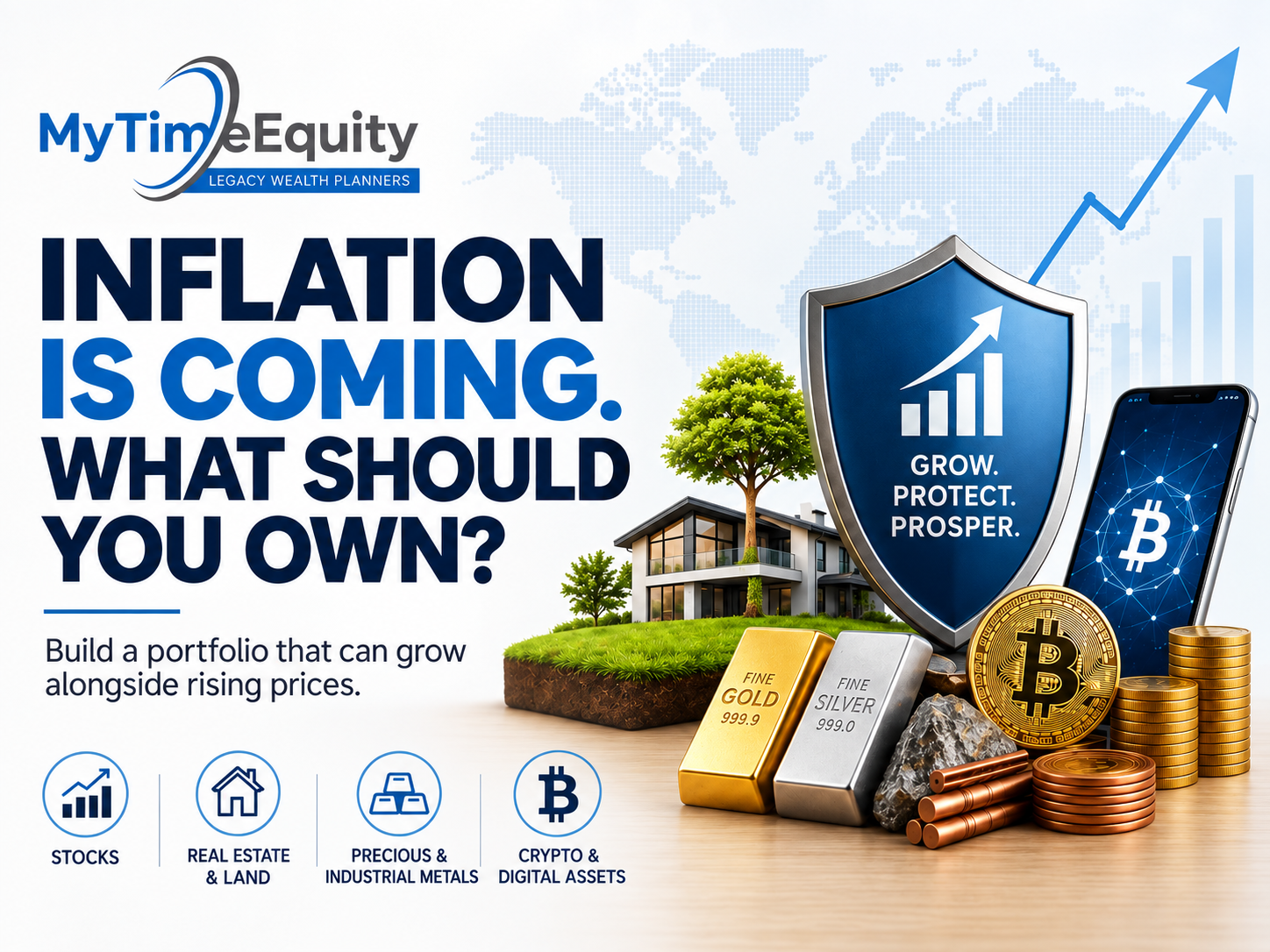
The alternative to holding cash is owning productive and scarce assets whose underlying economics can benefit from rising nominal prices and continued economic growth. The goal is not simply to avoid inflation. It is to own something that can grow alongside it.
Stocks
Many businesses can raise the prices of what they sell. Companies with strong brands, pricing power, recurring revenue and relatively light capital needs are often better positioned to protect margins and grow earnings as nominal prices climb. Over long periods, owning shares in productive businesses gives an investor a claim on the growth of the underlying economy, which is why equities remain a central piece of an inflation-conscious portfolio.
Real Estate and Land
Real estate offers a different form of tangible ownership. Construction costs, rents and replacement costs tend to rise with inflation, while the supply of desirable land stays fixed. Land in particular behaves nothing like cash: there is a finite amount of it, and its value ultimately comes down to location, scarcity and demand. For investors with the right time horizon and risk tolerance, real estate and land can provide exposure to values that rise as the nominal economy expands.
Precious and Industrial Metals
Gold and silver have served as stores of value during periods of monetary uncertainty for a long time. The opportunity extends beyond precious metals, though. Platinum, palladium and copper are tied to industrial demand, infrastructure, electrification and manufacturing, and to a broader economy that continues to consume more physical resources. These metals do not all respond to inflation the same way and can be volatile, but owning exposure to scarce physical resources is another way to hedge against a currency whose purchasing power keeps changing.
Crypto and the Digital Economy
Digital assets represent a newer form of ownership. As more economic activity moves online, and as governments continue to use monetary and fiscal policy to respond to economic stress, the case for scarce digital assets stays part of the broader conversation around protecting purchasing power. Crypto is highly volatile and should be sized accordingly, but a measured allocation can give investors who can tolerate that volatility exposure to the digitization of the financial system and to an asset with supply characteristics that differ fundamentally from fiat currency.
How different holdings tend to respond to sustained inflation
Holding | What Tends to Happen During Inflation |
|---|---|
Cash | Balance stays the same in dollar terms; purchasing power erodes if the after-tax return trails inflation |
Fixed-rate bonds | Nominal payments stay fixed; those payments buy less, and longer-duration bonds feel it most |
Stocks in businesses with pricing power | Companies raise prices on what they sell, which can protect margins and grow earnings |
Real estate and land | Rents, construction costs and replacement costs tend to rise with inflation; land supply is fixed |
Precious and industrial metals | Precious metals act as a store of value; industrial metals track demand from infrastructure and manufacturing |
Crypto and digital assets | Highly volatile; a measured allocation offers exposure to a supply structure that differs from fiat currency |
General tendencies discussed above. Actual performance varies by asset, time period and market conditions.
What Happens if Inflation Leads to a Recession?
Inflation does not always arrive alongside strong growth. If prices stay elevated while economic activity slows, the economy can move into a harder environment: weaker growth, tighter financial conditions and softer consumer demand.
The Federal Reserve's timing matters here. Higher rates may be necessary to contain inflation, but keeping financial conditions restrictive for too long raises the risk of tipping the economy into recession. Responding too late carries the opposite risk, letting inflation become more persistent. For an investor, that uncertainty is an argument for diversifying across assets rather than depending on a single source of return. Productive businesses, scarce real assets, land, selected commodities and metals, and potentially digital assets each provide a different kind of exposure to an economy where both inflation and monetary policy remain uncertain.
What You Own Matters More Than the Headline Number
Inflation is real, but its impact depends heavily on what an investor owns. Someone holding mostly cash watches purchasing power decline. Someone holding fixed-rate bonds keeps receiving the same nominal payments while those payments buy less. An investor who owns productive companies, real estate, land, scarce resources and other assets with room to appreciate participates in the growth of nominal economic value instead of simply absorbing it.
The goal is not to predict the exact path of inflation, interest rates or the next Federal Reserve decision. It is to build a portfolio that can hold up across different economic environments, one built on a stake in real businesses, properties and resources rather than a bet that prices simply stop rising.
Frequently Asked Questions
Why do cash and bonds lose ground during inflation?
Cash keeps the same dollar balance, but its purchasing power falls if inflation outpaces the after-tax return it earns. Fixed-rate bonds keep paying the same nominal amount, but that amount buys less as prices rise, and longer-duration bonds are the most exposed to this effect.
What assets can help protect against inflation?
Productive and scarce assets tend to hold up best, including stocks in businesses with pricing power, real estate and land, precious and industrial metals, and, for investors who can tolerate the volatility, a measured allocation to digital assets.
What happens to investors if inflation leads to a recession?
If prices stay elevated while growth slows, financial conditions can tighten and consumer demand can soften. Diversifying across productive businesses, real assets, land, metals and digital assets helps spread exposure across an economy where both inflation and monetary policy remain uncertain.
Key Takeaways
- Inflation changes the value of money and the value of assets at the same time. What you own determines which side of that change affects you.
- Cash and fixed-rate bonds lose real purchasing power when inflation outpaces their return, even though their nominal balance or payments stay the same.
- Productive and scarce assets, including stocks with pricing power, real estate, land, metals and a measured crypto allocation, can grow alongside a rising price level.
- If inflation persists alongside a slowing economy, diversification across these asset types spreads exposure to an uncertain inflation and monetary policy path.
Get in Touch
If you'd like to discuss how a portfolio of productive assets can help protect and grow your purchasing power against inflation, reach out at wealth@mytimeequity.com and we'll set up a time to discuss your investment strategy.
Prefer WhatsApp? Join our group for market updates and insights.
This briefing is for informational purposes only and does not constitute investment advice. Equities, real estate, precious and industrial metals, and digital assets each involve risk, including potential loss of principal; digital assets in particular are highly volatile and may not be suitable for all investors.
Disclaimer: MyTimeEquity is a state-registered investment adviser. Information shared is for educational and informational purposes only and should not be construed as investment, legal, tax, or accounting advice, or as a recommendation to buy or sell any security. Views expressed are subject to change without notice.