
Everyone Is Bracing for a Crash. The Bank Stocks Disagree.
Half of individual investors expect stocks to fall over the next six months. Bank stocks are trading well above their 2007 highs. Here is why that matters.
By Sudhir Pai, Managing Principal, MyTimeEquity
Turn on any financial show this month and you will hear some version of the same warning: a recession is coming, private credit is cracking, and the companies that borrowed heavily to build AI data centers are about to get the bill. One economist went on a major program last week and even put odds on a financial crisis.
Individual investors are listening. In the latest AAII survey, 51.4 percent said they expect stocks to be lower six months from now. That is a remarkable level of gloom with the S&P 500 sitting within a few percent of its all-time high.
So it is worth asking a simple question. If the financial system really were about to crack, where would the first signs show up? Not in a forecast. In the banks. And the banks are telling a very different story from the headlines.
Why we watch the banks
Banks sit in the middle of the economy. Mortgages, business loans and the credit lines funding those data centers all run through them. When loans start going bad, the damage hits bank earnings and balance sheets months before it reaches an economic report, and the investors who own bank stocks tend to see it early and sell.
That is exactly what happened last time. Bank stocks peaked in early 2007. The broader market kept climbing for most of the year and did not top out until October 2007. The banks broke first, and they told anyone watching that something was wrong long before the crisis made the front page. A genuine credit crisis rarely arrives any other way.
What the banks are saying now
Today the banks are doing the opposite of breaking down:
- The KBW Bank Index, which tracks the largest US banks, is about 40 percent above its early-2007 peak.
- The largest financial sector ETF has risen six weeks in a row to a new all-time high.
- The equal-weight version of that ETF, where a regional bank counts as much as the biggest bank, has done the same. The strength runs through the whole group, not just a few giants.
The starting point makes this more striking. In September, financial stocks fell hard for about a month, at the height of the fear. The same stocks that were supposed to be the first casualties have since recovered all of it and moved to new highs. For the collapse story to be right, this is the chart that has to fail first. So far it has not.
A big blow, quickly absorbed
The broader market has passed its own stress test this month. Nvidia, one of the three largest companies in the world, fell about 23 percent in 10 days after its chief executive stepped down abruptly, its worst 10-day drop since 2022. At one point it was about 31 percent below its high.
For two years, the common view was that Nvidia was holding up the whole market. If that were true, the S&P 500 should have fallen hard with it. Instead the index stayed within about 2 percent of its own high.
Investors did not abandon technology. They changed which technology they owned. Apple and Amazon reached 52-week highs, and on one day last week, with Nvidia still near its lows, AMD and Qualcomm each rose about 5 to 6 percent. Over the past 12 months, AMD has gained about 123 percent while Nvidia has lost about 15 percent. The money moved within the AI trade rather than out of it.
Rotation, not retreat
What happened inside technology is happening across the whole market. Leadership has changed hands roughly every two months this year, and technology alone has gone from laggard to leader and back again more than once.
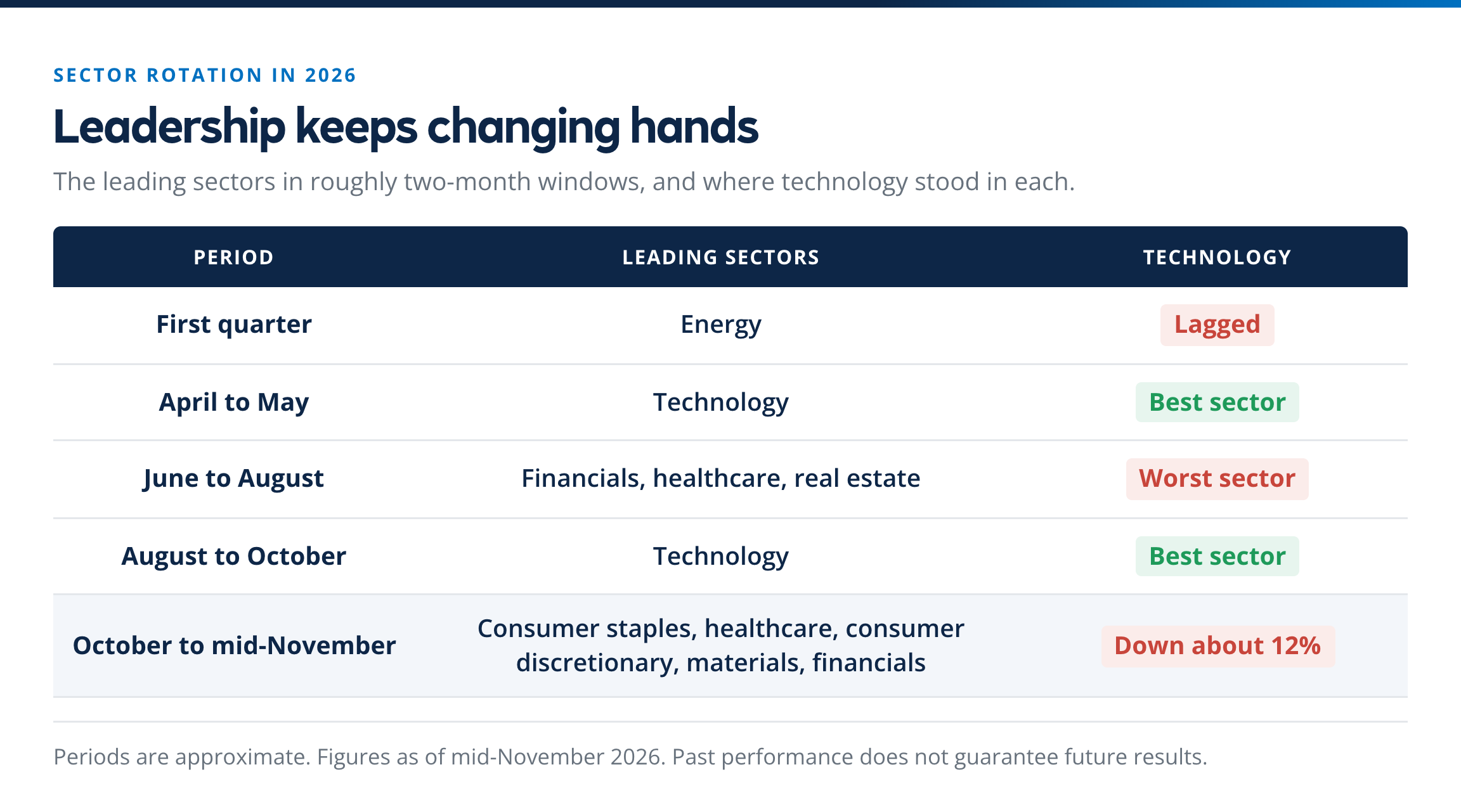
This kind of rotation is normal in a healthy bull market: when one group cools off, another picks up the slack. What matters is who is doing the leading. If only defensive sectors such as consumer staples were rising, that would be a warning sign. Instead, financials, materials, healthcare and consumer discretionary have all been leading over the last six weeks.
The rally is broad, too. For most of the last two years, the complaint was that only a handful of giant technology companies were going up. In October, the average stock rose about 5 percent and the median stock about 7.5 percent, and around 70 percent of stocks are now back above their 50-day moving averages. Outside the US, Germany, Canada and Australia have hit record highs along with much of Europe, and India's Bank Nifty index is at a record despite worries that AI would hurt the country's IT services industry.
Prices move before the news
The banks in 2007 were an example of a broader rule: stock prices tend to reflect what investors expect six to twelve months out, not what happened last month. Housing shows the same thing today. Existing home sales in October fell to their lowest level since August 2010, yet homebuilder stocks such as PulteGroup and Toll Brothers are pressing against all-time highs.
We are not predicting a housing boom, and higher mortgage rates are squeezing the builders. The point is that when prices and headlines disagree this sharply, the prices deserve your attention first.
What would change our view
None of this means the risks have gone away. The concerns about private credit and heavy AI borrowing deserve close watching, and three signals would make us more cautious:
- Bank stocks fall back below their 2007 highs and keep falling. That is the first chart to watch.
- Semiconductor stocks break below their July lows, which would suggest investors are leaving AI altogether rather than rotating within it.
- Long-term interest rates climb sharply. Long-dated Treasury bond prices are already near record lows, and more pressure there would spread to stocks.
The economist on television may yet be proven right. But if a crisis is coming, history suggests the banks will be among the first to show it, and today they are pointing the other way.
What this means for you
The same news can call for different actions from different investors, depending on goals, time horizon and tolerance for risk. Still, a few principles hold up well in a moment like this:
- Weigh evidence over opinion. Forecasts are everywhere. Bank stocks, market breadth and the direction of money flows are evidence.
- Do not let fear sell your best holdings. In midterm election years like 2026, investors often sell good companies in the autumn and then watch the market rally without them. If a position has grown too large, trim it as part of a rebalance, not because of a headline.
- Own more than one story. With leadership changing every couple of months, diversification is doing real work this year, a point we made in Not Everything Moves Together.
- Use the dispersion. When some holdings sit at highs and others are below cost, there may be room to harvest losses for taxes while staying invested.
- Decide your signposts now. Know what would make you more cautious, such as the three signals above, so any change is made with a clear head rather than in the middle of a selloff.
Fear makes for good television. It rarely makes for good portfolio decisions.
Questions about your own portfolio? Write to us at wealth@mytimeequity.com.
Data note: Market figures are as of mid-November 2026. Sentiment data is from the American Association of Individual Investors. Companies, indexes and funds are named for illustration only and are not recommendations. This post is for information and education only. It is not investment advice or a recommendation to buy, hold, or sell any security. Past performance does not guarantee future results. Every investment decision should be your own, based on your situation and your advisor's guidance.
MyTimeEquity. MyTimeEquity, LLC is registered as an investment adviser with the U.S. Securities and Exchange Commission (SEC File No. 801-136955). Registration does not imply a certain level of skill or training. MyTimeEquity, LLC (“MTE”) is a registered investment adviser based in Plano, Texas, serving investors who want ongoing advice on a managed portfolio rather than participation in individual private-market transactions. MTE is a separate firm from MTE Private Equity LLC (MTEPE), an affiliate under common ownership. MTE also acts as investment adviser to certain private funds with which MTEPE is involved, and those funds pay management fees to MTE’s affiliates; this conflict of interest is described in MTE’s Form ADV Part 2A and Form CRS. Advisory services are offered only by MTE, only under a written advisory agreement, and never by MTEPE. Information MTE shares is for educational and informational purposes only and is not investment, legal, tax, or accounting advice, or a recommendation to buy or sell any security. All investments involve risk, including the possible loss of principal, and past performance is not indicative of future results.